

In the hollow remains of a vacant Campbell Soup factory located in Toronto’s west end, Canada’s minister responsible for artificial intelligence and digital innovation revealed the federal government’s most significant investment to date in domestic technology that has the potential to transform artificial intelligence, medical research, and various essential sectors of the economy.
Addressing the backdrop of the ongoing Canada-U.S. trade dispute, along with U.S. President Donald Trump’s recurrent threats to Canadian autonomy, Evan Solomon emphasized national pride while announcing a substantial $195 million in repayable federal investment for Xanadu Quantum Technologies, a Toronto-based firm.
“This marks a truly remarkable day for Canada, for Xanadu, and I believe for the scientific community globally,” he stated on Friday. “It exemplifies what Canadians excel at: We create.”
Solomon asserted that Canada is poised to take “significant risks” in pursuing this goal.
“We are not just going to invest in addressing the world’s most pressing challenges and achieving excellence… We’re going to go all in, without fear.”
Established in 2016, Xanadu develops software and quantum computers that operate on light rather than electricity. In contrast to conventional computers that produce heat from electric currents moving through metal wires, Xanadu’s chips manipulate light particles without generating electrical resistance.

Evan Solomon, Canada’s minister of artificial intelligence and digital innovation, announces $195 million in repayable federal funding for Toronto-based Xanadu Quantum Technologies on Friday in Toronto. (Submitted by Xanadu Quantum Technologies)
Unlike other quantum computers that necessitate intense, energy-consuming cooling systems, Xanadu’s devices primarily function at room temperature.
In June of last year, the firm introduced a groundbreaking chip capable of producing error-resistant photonic qubits, the fundamental data unit for quantum computing.
“Nations that develop a fault-tolerant quantum computer will have the ability to compromise cybersecurity,” Solomon noted.
“This is why nations like China, the United States, and countries in Europe are in fierce competition. The leading companies are based right here in Canada, and the intellectual property is ours. Therefore, from a national security perspective, this technology is absolutely critical.”
‘Like riding a rocket’
The announcement took place within the confines of the former Campbell’s Soup factory in Toronto, where Xanadu intends to establish advanced manufacturing for its fault-tolerant, utility-scale photonic quantum computers. The facility, spanning 158,000 square feet, is projected to cost $893 million and create 275 jobs.
“If digital computing feels like riding a horse, then quantum computing is akin to riding a rocket,” Solomon remarked. “It’s exponentially faster.”
In 2023, the federal government launched a $360-million National Quantum Strategy. The $195-million repayable financing commitment to Xanadu stands as its largest single investment in quantum technology manufacturing.
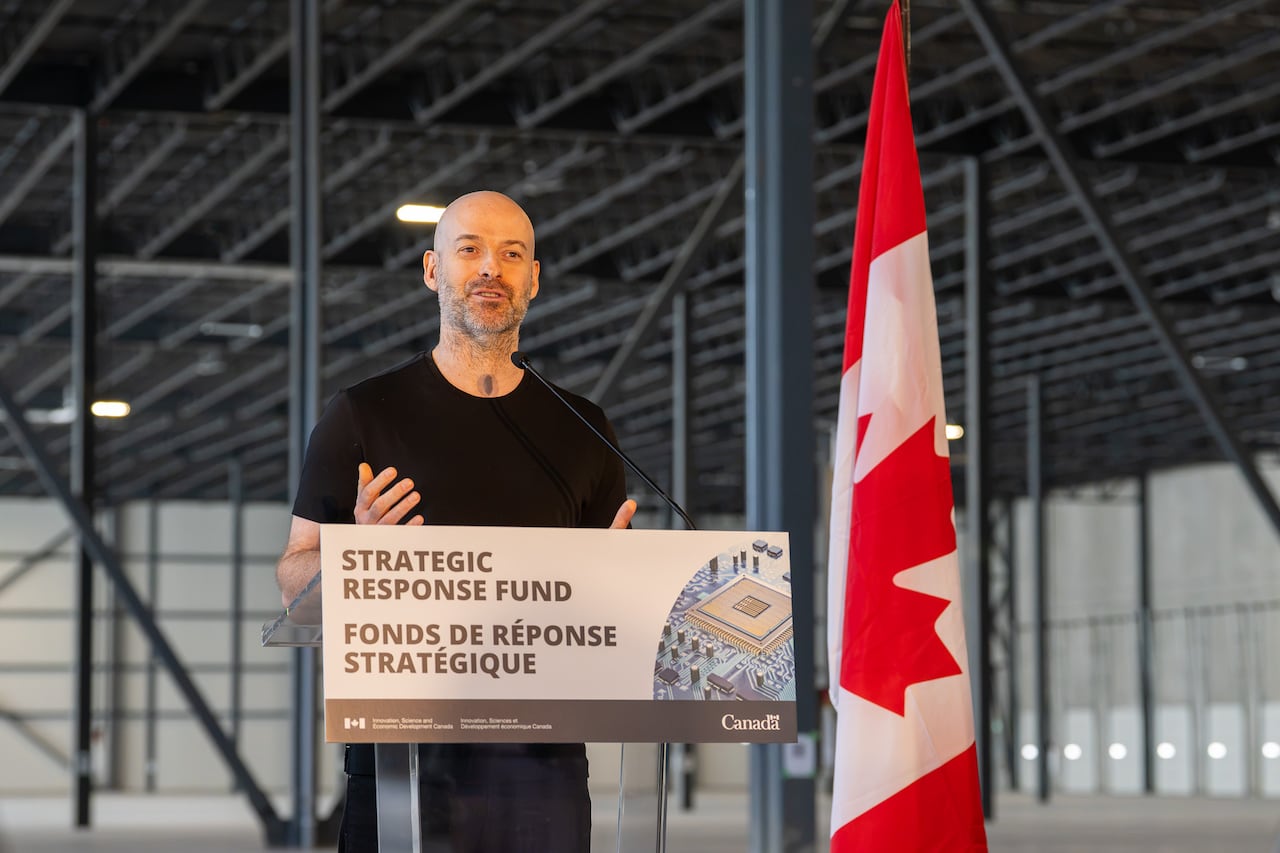
Xanadu CEO Christian Weedbrook states that the federal funding will enhance the company’s presence in Canada. (Submitted by Xanadu Quantum Technologies)
The recent announcement ranks among the most significant single-company investments in Canada’s tech industry. A notable example was in 2024 when the government allocated a $2.14-billion loan to Telesat, a satellite operator based in Ottawa.
In March, Xanadu disclosed that it was in talks with both the federal government and the Ontario provincial government for up to $390 million in combined financial assistance to develop advanced semiconductor and photonic manufacturing in Canada.
Xanadu CEO Christian Weedbrook indicated on Friday that discussions regarding up to $195 million in funding with the Ontario government are “still ongoing,” characterizing the talks as “final negotiations and discussions.”
The company clarified that Friday’s announcement reflects Ottawa’s complete contribution. Unlike a conventional loan, there is no set repayment date. The funding will be sourced from Innovation, Science and Economic Development Canada’s Strategic Response Fund, which previously granted $40 million to Xanadu in 2023.
‘Obligations to keep the jobs here’
Weedbrook, originally from Australia, expressed that the funding will strengthen his company’s operations in Canada.
“A facility that once nourished Canadians will now contribute to the development of next-generation technology,” he remarked. “Our current location will enable us to conduct most of this work right here in Toronto, Canada.”
In May, the U.S. government announced an investment of approximately $2 billion USD in nine quantum firms.
Xanadu is expanding its presence in the United States. In 2025, it secured collaborations with the U.S. Department of Defense and the U.S. Air Force Research Laboratory. The company is also associated with prominent U.S. corporations, including Lockheed Martin and chipmaker AMD.
-
University of Calgary to house quantum defence hub to develop tech for armed forces
-
Audio
Xanadu CEO on Canada’s quantum future
“I believe there are responsibilities to retain the jobs here for an extended period,” stated Amy Karam, a business consultant and fellow at the Canadian Global Affairs Institute.
“Having the government involved in business decision-making is a vital way for our country to encourage companies to remain. Just providing funding and conducting research isn’t sufficient anymore.”

Xanadu intends to name its 158,000-square-foot photonics hub, depicted here in a digital rendering, after the acclaimed Christopher Nolan film, Inception. (Submitted by Xanadu Quantum Technologies)
In March, Xanadu listed its shares on both the Toronto Stock Exchange and the tech-focused Nasdaq. This latter move elevates the company’s visibility among U.S. investors, as its stock now trades alongside well-known entities like Apple, Microsoft, and Nvidia.
“It’s a significant challenge to persuade companies to stay here,” Karam remarked.
“According to the Global Innovation Index, we are experiencing a drastic decline,” she added.
“We need to undertake serious efforts to catch up. It’s essential to regain our global leadership in technology, and I am confident that this government recognizes this and is taking action accordingly.”
Matthew da Mota serves as a senior policy researcher at the Canadian SHIELD Institute, a Toronto-based think tank founded by BlackBerry co-founder Jim Balsillie to reform public policy on technology and national security and protect Canadian intellectual property.
Da Mota indicated that the advancements made by Xanadu, which range from developing new pharmaceutical treatments to enhancing cybersecurity, could pose risks if mismanaged.
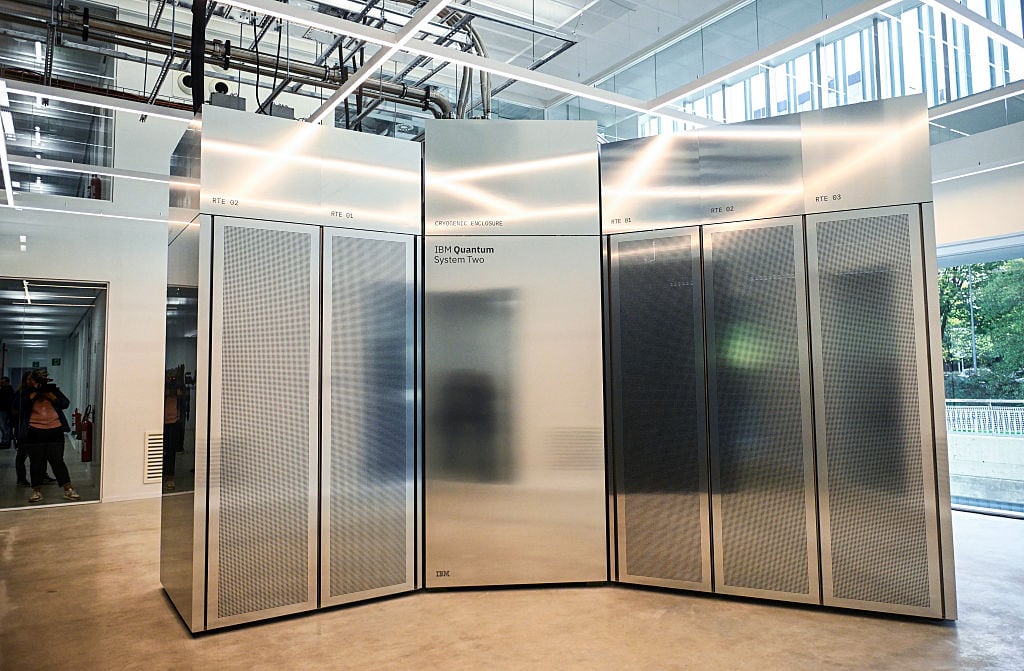
The IBM Quantum System Two quantum computer is displayed at the inauguration of the IBM-Euskadi Quantum Computational Center in the Basque Foundation for Science Ikerbasque headquarters in San Sebastian, Spain, on October 14. (Ander Gillenea/AFP/Getty Images)
“This technology allows for extremely rapid processing and computation, enabling multiple tasks to be executed simultaneously in ways that traditional computing could not achieve. It also holds the potential to compromise existing encryption,” he explained.
“This poses significant threats to Canada and its allies; however, it could also serve as a powerful long-term tool for cybersecurity.”

Google stated that it has overcome a key obstacle in quantum computing with the introduction of a new generation of the Willow chip, resolving a computing issue in five minutes that would take a classical computer more time than the entirety of the universe’s existence.
In discussions with reporters, Solomon minimized the risks associated with the government making a significant investment in a single company that is at the forefront of an emerging technology.
“If Canadian companies are not leading in quantum computing, we will face vulnerabilities in the future,” he stated.
“From a security standpoint, a scientific perspective, and an economic viewpoint, it’s crucial for this country to ensure that the leading companies globally are operating here in Canada.”