

At the age of 71, Hilarion Thériault recognized that his end was near and chose to draft a will—an unusual step for Acadians during the 19th century.
This rarity stemmed from the fact that a majority of Acadians had little property to bequeath. Following the Acadian deportation, many were stripped of their land and homes. Furthermore, Roman Catholics in the region were prohibited from owning property until the late 1780s. Although many lived and worked the land, they faced significant challenges in securing ownership titles for decades.
However, as Thériault stated in his will, he was “unwilling to die unprepared.”
Colby Gaudet, a post-doctoral researcher at Dalhousie University, examined Thériault’s will along with 23 others from the small Acadian community of Clare, N.S., to gain insights into how families managed the legal and spiritual aspects of mourning and mortality.
“It’s both a form of resistance and compliance. [Acadians] utilized the existing framework of Anglophone property lines,” Gaudet explained. “Yet they also emphasized that this was the testament of a Roman Catholic.”
Thériault specified in his will that his debts should be settled and that reparations for any injustices should be honored in his memory. He also expressed a desire to provide peace for his family.

Colby Gaudet is a researcher and a descendant of some individuals mentioned in these wills. (Colby Gaudet)
Historian Maurice Basque, affiliated with l’Institut d’études acadiennes at the Université de Moncton, noted that these wills were created amidst considerable social ostracism of Acadians.
In 1755, Lt.-Gov. Charles Lawrence commanded the expulsion of the Acadians due to their refusal to pledge allegiance to the British Crown. Thousands were uprooted from their homes, while many sought refuge in the wilderness or fled to Quebec.
Basque explained that Acadian land was claimed by the Crown, which redistributed it to settlers from New England.
“For decades, the British aimed to replace the Acadian population,” Basque stated.
Some Acadians managed to return years later, but they were not greeted warmly.
Basque pointed out that they were systematically barred from obtaining certain positions of authority through oath tests designed to compel individuals to renounce fundamental Catholic beliefs.

Maurice Basque is a historian at Université de Moncton. (Submitted by Maurice Basque)
Consequently, Gaudet noted that all county judges overseeing wills in the area were Anglo-Protestants, creating a language barrier for the Acadians, who had to compose their wills in a language unfamiliar to many.
All the wills Gaudet reviewed were authored by a priest named Jean-Mandé Sigogne, who left France due to the French Revolution, found refuge in London where he learned English, and eventually arrived in Clare in 1799.
“This priest acted as the intermediary between the local community, his parishioners, the Francophone Acadian families, and the judicial system,” Gaudet remarked.
Unapologetically Catholic
The wills examined by Gaudet were primarily written by community figures. For instance, Thériault was among the founding churchwardens of the parish.
Given that the church and Catholicism were deeply woven into their daily existence, many individuals ensured that their wills reflected this devotion, despite societal disapproval at the time.
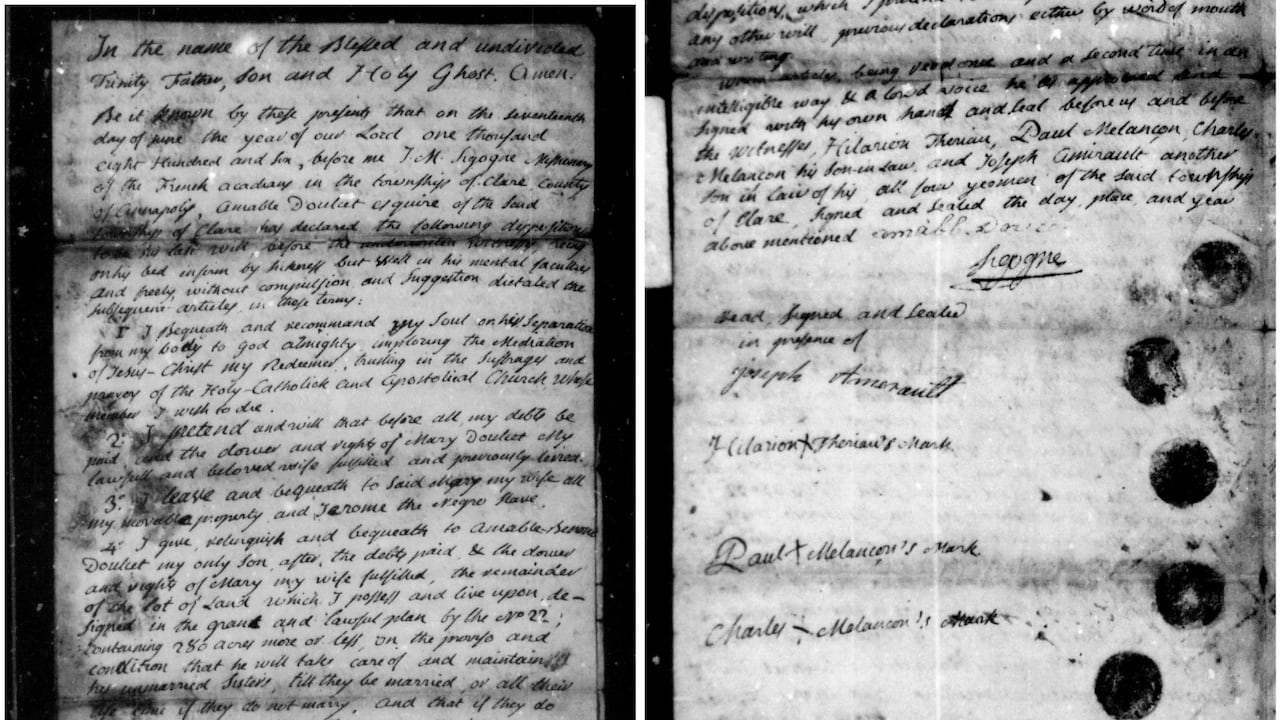
Amable Doucet’s will, authored by Catholic priest Jean-Mandé Sigogne. (Nova Scotia Archives)
“Protestant wills might merely invoke the name of God, amen,” Gaudet explained. “In contrast, there are specific Catholic elements, such as the invocation of the Virgin Mary and others.”
He noted that some wills, like that of Argyle resident Paul Surette, explicitly referenced saints. Surette’s will mentioned “the Sufferance of the Blessed Virgin Mary, the Holy Apostles and especially St. Paul my Patron and of all the Saints.”
Racial relationships in Clare
The wills also provided insights into the dynamics between Black individuals and Acadians.
In fact, Gaudet began his research into wills after discovering the will of Amable Doucet, which included a provision for a Black slave named Jerome, who was bequeathed to his wife along with his other possessions.
In another will he analyzed, Étienne Thibodeau named his neighbors Paul Dugas and Anselm Hatfield as witnesses. Hatfield, a Black man from New York, had been an indentured servant to Dugas and was a free man residing in the community.
MORE TOP STORIES
-
An Acadian flag emoji? Online petition gathers thousands of signatures
-
‘It was unbearable’: Halifax tenants call for indoor temperature cap
-
Adsum House ‘sickened’ by past misogynistic song made by N.S. cabinet minister
-
West Chezzetcook celebrates the past and future of its culture on National Acadian Day
-
At Canada’s largest keel-boat regatta, advocates hope to see more women ride the wind