

Liberia has consented to take in as many as 1,200 deportees from third countries over the upcoming year, with an initial batch of 20 anticipated to land on Thursday, according to a statement from the government.
In a statement released on Tuesday, the Liberian government noted that the deportees “will consist of individuals or nationals from African and Western Hemisphere nations who have been medically cleared for travel.”
Details concerning the nationalities of these deportees were not immediately available, as the U.S. State Department does not disclose such information.
Historically, the U.S. has adhered to the principle of non-refoulement, both in its domestic laws and through international agreements. This principle prevents the return of migrants to their home nations or other countries where their human rights or even their lives and freedoms may be at risk due to factors like race, religion, or nationality.
However, since assuming office in January 2025, the administration of U.S. President Donald Trump has forged various agreements with several African nations, as well as other countries globally, to deport individuals who cannot be sent back to their home countries. Washington has defended these third-country arrangements as legal, and courts have been hesitant to intervene in executive actions, although some have criticized the insufficient notice provided to those being deported.
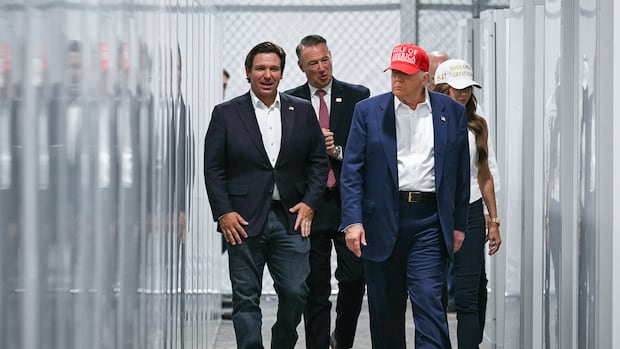
A growing network of U.S. companies are getting billions from the Trump administration to carry out its immigration crackdown. For The National, CBC’s Jonathan Montpetit breaks down how ICE detention turned into a big money business, and what it means for the people who find themselves locked up.
Immigration attorneys have asserted that the Trump administration exploits third-country deportations as a legal loophole, as many migrants are sent to locations they have never been, leaving them with limited options to return to their original countries.
Liberian President Joseph Boakai was among five West African leaders who visited the White House last year to engage with Trump. According to a report by Reuters, Trump had urged these leaders to accept third-country deportees.
On Tuesday, Liberia announced that the incoming deportees would be treated “as guests,” who would have the freedom to leave whenever they choose and could seek asylum in Liberia. The government emphasized that the agreement did not entail any quid pro quo with Washington, and Monrovia was not seeking compensation for hosting the deportees.
-
On immigration, Trump administration has chalked up many more wins than setbacks
-
Despite the war, the U.S. and Iran are working together to deport asylum seekers, lawsuit says
However, a report from February by several Senate Democrats described these agreements as inherently exploitative. They claimed that arrangements with just five countries—Equatorial Guinea, Rwanda, El Salvador, Eswatini, and Palau—had cost U.S. taxpayers $32 million.
“Deportation is being utilized as a bargaining tool,” the senators stated. “It is being carried out through undisclosed cash transactions and subtle concessions. Countries are being coerced with threats of tariffs, visa restrictions, or cuts to aid.”
Other African nations that have received U.S. third-country deportees include the Democratic Republic of Congo, Central African Republic, Cameroon, Ghana, and Sierra Leone.

U.S. moves to end TPS for Ethiopians in country
These deportations are part of a broader approach by the Trump administration aimed at decreasing the foreign-born demographic in the United States. The government has encouraged unauthorized individuals in the country to self-deport and recently announced the revocation of over 175,000 visas from foreign nationals.
On Tuesday, a federal judge permitted the Trump administration to terminate legal protections that had been granted to over 5,000 Ethiopians, allowing them to live and work in the U.S. This follows similar rulings by judges in recent weeks involving individuals originally from South Sudan, Myanmar, and Somalia.
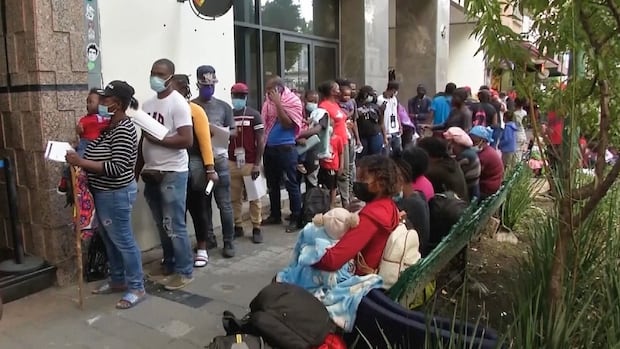
In June, the U.S. removed protections that prevented Haitians from being deported. Now, some advocates say Canada needs to rethink its Safe Third Country Agreement with the U.S. for Haitians seeking asylum.
U.S. District Judge Brian Murphy in Boston removed the final judicial obstacle preventing the Department of Homeland Security from ending the temporary protected status (TPS) designation for specific countries after the U.S. Supreme Court allowed the administration in June to withdraw similar protections for thousands from Haiti and Syria.
These protections have facilitated the entry of individuals into the U.S. since the 1990s, particularly from nations facing armed conflict or environmental catastrophes like hurricanes and earthquakes. Trump and numerous Republicans in Congress have contended that these statuses were never intended to be permanent and that some recipients could have pursued asylum upon their arrival.
-
Haitians in the U.S. brace for deportation as Trump ends their protected status
-
Trump says ICE won’t halt traffic stops after recent fatal shootings despite earlier order
The U.S. Chamber of Commerce has been one of the entities opposing the termination of TPS protections, arguing that it would negatively impact the U.S. economy and deprive crucial sectors like construction and healthcare of necessary labor during a period marked by demographic challenges due to retirements and declining birth rates.
Additionally, the U.S. Conference of Catholic Bishops has condemned the “villification” of migrants in the nation, issuing a rare statement that received backing from Pope Leo, the Chicago-born pontiff.