

On Wednesday, U.S. President Donald Trump declared via social media his intention to initiate what he termed “the MOST CRUSHING ECONOMIC OPERATION EVER TAKEN AGAINST ANY COUNTRY!” in relation to Iran.
He described this initiative as “Economic Warfare and Isolation on an unprecedented scale” in a post on Truth Social, but provided limited specifics.
Trump further cautioned that any nation aiding Tehran or offering “any type of lifeline to Iran” would face economic repercussions.
“ANY country that allows its financial institutions, businesses, airports, or government entities to provide any type of lifeline to Iran will itself face TREMENDOUS Economic Consequences,” Trump stated in his social media message.
He did not clarify the precise measures Washington would impose on such nations, nor did he mention any specific countries. He wrote: “Oil smuggling, swap lines, cash transfers, exchange houses, ship registries, front companies — It all needs to stop NOW. You know who you are.”
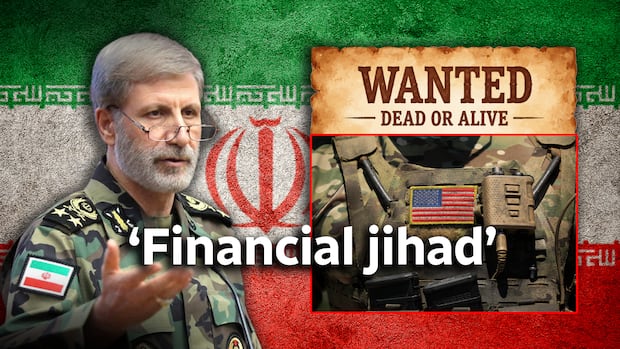
Iran is offering a $30,000 US bounty to any Iranian who can capture or kill American soldiers. Andrew Chang breaks down why the timing of the announcement matters, its propaganda value, and how realistic it actually is.
(Photo credits: The Canadian Press, Reuters, Adobe Stock and Getty Images)
The ongoing six-month conflict has resulted in thousands of deaths and has quickly involved multiple nations in the Gulf region. Global markets have reacted sharply as Iran has demonstrated its capability to control shipping routes through the Strait of Hormuz, a critical passage where approximately one-fifth of the world’s traded oil flowed before February.
The U.S. and Iran have previously declared ceasefire agreements in April and June, aimed at restoring the free flow of shipping through Hormuz to pre-war conditions as a step toward resolving the conflict. However, both agreements rapidly fell apart even as Israel largely pulled back from the fighting that commenced alongside the U.S. in February.
Trump’s statements on social media often lack detailed follow-up or effective implementation as stated.
Conflicting accounts of U.S.-Iran talks
On Tuesday, the United Arab Emirates, which hosts a significant U.S. military installation, declared a suspension of all trade activities, commercial exchanges, and financial transactions with Iran until further notice.
This announcement followed reports from the UAE defense ministry about two missiles launched from Iran that landed in the sea, a claim that Iran dismissed as unfounded.
According to data from analytics firm Kpler, China purchases over 80 percent of Iran’s exported oil. Engaging in further economic conflict with China—an important U.S. trading partner that supplies essential rare-earth minerals—could provoke retaliation.
On the same day, Mohammad Mokhber, an adviser to Iran’s supreme leader, indicated that Iran is willing to engage in dialogue with the U.S. but does not equate negotiations with capitulation. Mokhber stated that military pressure and sanctions would not weaken Iran’s determination, as reported by the semi-official Fars news agency.
On Tuesday, Trump asserted that no negotiations were occurring with Iran. Conversely, a day earlier, Jared Kushner, Trump’s son-in-law and special envoy, conveyed an optimistic view, stating that discussions with Iran were still in progress and were “probably more robust” than ever.