

Researchers have identified a crater on the moon that surpasses the size of the Roman Colosseum, resulting from a significant impact event that occurred two years ago and went unnoticed at the time.
This steep-sided depression measures 222 meters in diameter and reaches depths of up to 43 meters, marking it as the largest known impact crater in the solar system created in recent history.
Such an extensive event is projected to happen only once every 132 years, providing a wealth of knowledge as NASA gears up to establish a base for astronauts on the lunar surface.
“This occurrence represents a statistically rare, essentially once-in-a-lifetime observation,” the researchers stated in one of two studies published on the topic on Wednesday in the journal Science Advances.
The crater was detected by NASA’s Lunar Reconnaissance Orbiter (LRO) in May 2024, shortly after it was created by a fragment from an asteroid or comet. The impact on the moon was not captured in real-time by telescopes located on Earth or in space.
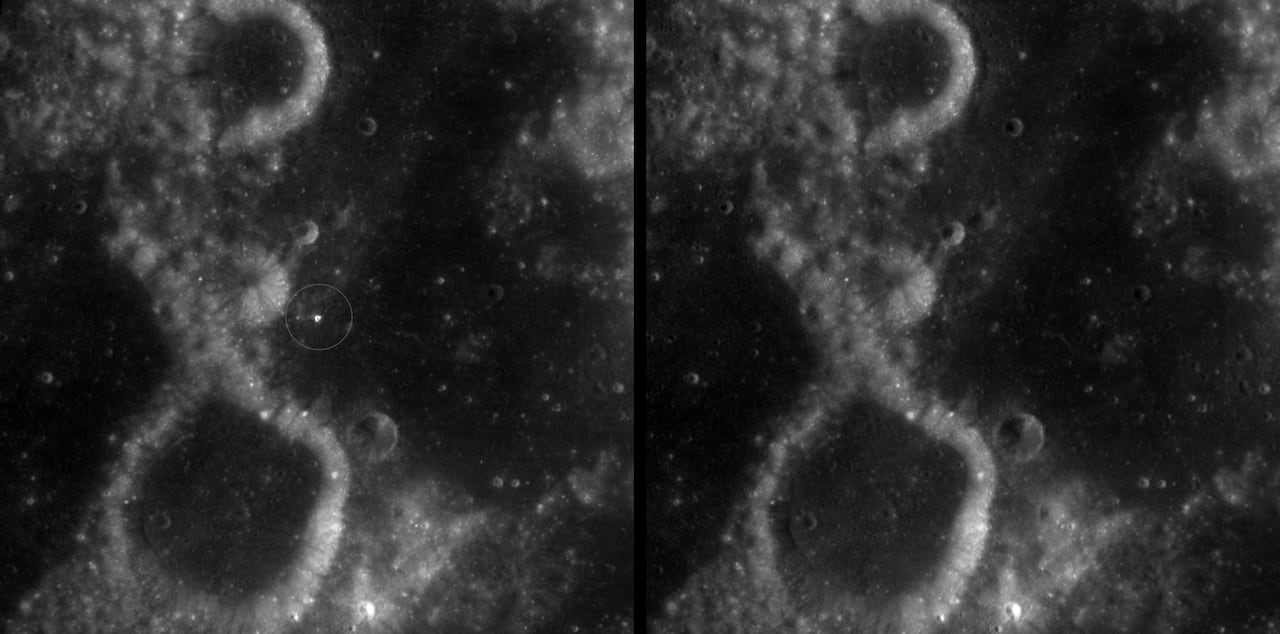
A zoomed-in view of McGetchin Crater, circled on the left, next to a ‘before’ image on the right. (NASA Goddard/Intuitive Machines/Robert Wagner)
The wide-angle images captured by the LRO went unnoticed among the vast amount of data until August 2025. The spacecraft acquired more detailed images in the fall, with confirmation of the crater’s existence occurring earlier this year.
This newly discovered crater is named in honor of the late Thomas McGetchin, who was a former director of Houston’s Lunar and Planetary Institute.
Similar to Gardening
The moon, which has been pockmarked for millennia, contains some of the largest impact craters in the solar system, including one that spans over 2,400 kilometers.
The recent impact disturbed the lunar surface over a distance exceeding 100 kilometers, with dust and rocky debris being ejected at angles higher than anticipated, according to Mark Robinson, the chief scientist for the LRO’s cameras at Intuitive Machines. Robinson served as the lead author for one of the studies.
-
Here’s the mark a SpaceX rocket crash left on the moon
-
Astronauts’ movement increased subsurface temperatures on the moon, study finds
Another study found a seven-kilometer-wide cold area surrounding the new crater, which aligns with a loosening of the moon’s surface soil. Co-author David Paige from the University of California, Los Angeles, compares this phenomenon to gardening.
“We are now considering impacts as a method to garden the regolith — mixing the sediments and bringing materials that are typically buried to the surface,” Paige explained in a statement. (Regolith refers to the loose, solid material above bedrock.)

An overhead, close-up view of McGetchin Crater that was taken on Dec. 5, 2025, by NASA’s Lunar Reconnaissance Orbiter. (NASA Goddard/Intuitive Machines/Robert Wagner)
Since its launch in 2009, the LRO has made numerous crater discoveries, indicating that the top two centimeters of lunar soil are being disturbed by ejected materials every 80,000 years, a rate faster than previously estimated, according to Robinson.
Despite the common belief that the footprints of the Apollo astronauts will last indefinitely, Robinson noted in an email that they will “definitely be long gone within that timeframe.”
The next phase involves assessing the risk of debris from the crater impacting NASA’s proposed lunar base, he added.
“This information will assist engineers in fortifying structures so that there is less concern about potential damage,” he remarked.