

Canadians preparing for billions in counter-tariffs will not only witness a surge in prices for American aluminum, toilet paper, furniture, and more, but also on the semi-trailers transporting these items into and throughout the nation.
Ocean Trailer, the leading semi-trailer retailer in Western Canada, is anticipating a $45-million order of 600 trailers from manufacturers in the U.S.
The company is making efforts to import as many of these trailers as possible before a 25 percent counter-tariff on trailers, along with numerous other items, comes into force on Tuesday.
Mack Keay, the chief operating officer of Ocean Trailer, stated to CBC News from Vancouver, “The additional cost of 25 percent exceeds our profit margin on a trailer, so we would have no choice but to pass that expense onto the customer.”
The federal government has announced that countermeasures will begin at 12:01 a.m. on Tuesday, affecting $27.6 billion worth of U.S. products, in response to the latest tariffs enacted by President Donald Trump’s administration.
Keay mentioned that Ocean Trailer might cancel part of its order, which was supposed to arrive trailer by trailer until year-end, but they are still committed to the trailers already in production in the U.S.
Trailers that cannot be imported into Canada by September 8 will need to be stored in the U.S. or sold to retailers based there, with Keay noting that he wouldn’t recoup the costs incurred.
Industry ‘very much concerned’
Ocean Trailer is not the only business facing challenges.
The leader of the Manitoba Trucking Association highlighted that the majority of semi-trailers in Canada are sourced from the U.S.
Executive director Aaron Dolyniuk commented, “I know several members who currently have trailers on order and are extremely worried about the costs, as they placed those orders prior to the counter-tariffs.”
Dolyniuk expressed uncertainty about whether they can afford to pay the 25 percent increase when the trailers arrive.
He also noted that many businesses that depend on trucking services are “hurrying to get their shipments across the border before the [counter-]tariffs take effect.”
“I spoke with one member late last week who mentioned that they usually transport two loads for a single customer northbound, but this week they wanted 15,” he added.
Various types of semi-trailers are utilized on Canadian roads, with dry vans and refrigerated vans being the most prevalent.
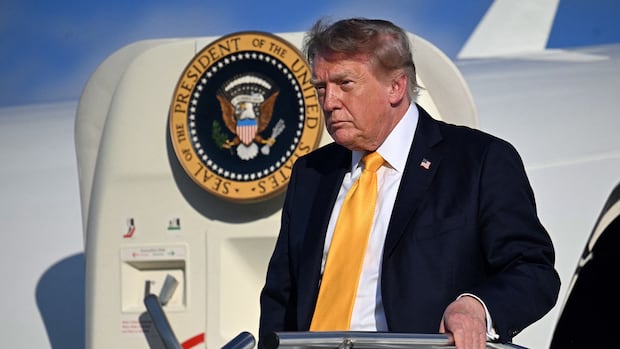
A day before Canada’s counter-tariffs on the U.S. are expected to go into effect, an international affairs expert says the fallout from this phase of the trade war could be ugly because of the president’s volatility.
Refrigerated vans, often called “reefer” vans, transport groceries, pharmaceuticals, and other temperature-sensitive goods to prevent spoilage during transit.
Dry van trailers carry a wide range of products, including kitchen appliances, car and machinery parts, paper items, furniture, televisions, canned foods, and other non-perishable goods.
‘This is not going to be OK’
In Canada, there are only two manufacturers of semi-trailers — one located in Ontario that does not produce reefer van trailers and another in Quebec that manufactures both reefer and dry vans, as well as flat freight vans and other specialty types.
Neither company could quickly adapt to the heightened demand for trailer orders or rentals from Canadian trucking firms following the counter-tariffs.
Keay from Ocean Trailer remarked that Canada’s domestic manufacturing capabilities are less than half of what the trucking industry would require to satisfy demand.
At the industry level, the potential costs added by the counter-tariffs are significant.
Keay indicated that the average price across various trailer types is around $75,000. A 25 percent tariff would push that figure to nearly $95,000.
Each of Ocean Trailer’s seven branches, from Manitoba to British Columbia, is currently receiving one or two trailers each day, whether related to trucking company orders or for inclusion in the company’s rental fleet, according to Dallas Senebald, the manager of the Winnipeg branch.
Senebald expressed, “This is not going to be OK. Not just for us, but the entire industry will face challenges,” adding that his Winnipeg office has 40 employees.
“There will be a trailer shortage, which will escalate demand, raise trailer prices, and that will ultimately affect consumer goods that need to be transported.”
If this lasts many weeks … there could be companies going bankrupt.Aaron Dolyniuk, Manitoba Trucking Association
Senebald noted that sales patterns for semi-trailers can be unpredictable from year to year, influenced by the supply and demand for items requiring transportation.
For instance, a larger corporate client may order 100 trailers one year, then none the following year, he explained. The Winnipeg branch might receive 300 to 400 trailers in one year and only 80 the next.
This variability is one reason the industry operates on a mixed supply model. Ocean Trailer collaborates with approximately eight suppliers, seven from the U.S. and one from Mexico, according to Senebald.
In addition to being the largest semi-trailer retailer west of Ontario, it is also the foremost rental business.
In the short term, Canadian trucking companies may opt for rentals as they postpone purchasing U.S. trailers that are now 25 percent more expensive due to counter-tariffs, warned Senebald — a situation that raises concern.
He added, “The demand for rentals will surge to such an extent that we likely won’t have enough to meet customer requirements.”
“Consistently having to decline customer requests is never advisable. Eventually, they will stop reaching out.”
Dolyniuk from the trucking association stated that the severity of the impact will ultimately hinge on the duration of the tariff conflict.
“If this situation persists for many weeks, it could lead to bankruptcies within the trucking industry and beyond,” he warned.