

Tiff Macklem, the Governor of the Bank of Canada, has indicated that the risk of inflation is increasing, primarily due to surging energy prices, which are now the leading potential factor for rising costs faced by consumers and businesses, following Canada’s reciprocal tariffs on U.S. goods.
During a press briefing on Wednesday, Macklem’s comments followed the Bank of Canada’s decision to maintain its key interest rate at 2.25 percent, a move anticipated by economists. The central bank had reduced the rate to its current level in October of the previous year, marking the seventh consecutive occasion it has kept its benchmark rate unchanged.
Macklem stated, “The counter-tariffs, as well as the U.S. tariffs, will increase costs for certain businesses.” He noted, “These tariffs are quite substantial, but they affect a relatively small segment of the market.”
He emphasized that the more significant concern is the ongoing conflict in the Middle East.
Macklem remarked, “The situation has escalated again. Oil prices are rising once more. The longer this continues, the greater the risk of it influencing the prices of various goods and services.”
In its statement, the bank noted that recent data supports its forecast of a “broadening recovery” in the economy. However, it also highlighted that both the war and U.S. tariffs present an increased risk of inflation.
Since the bank’s last announcement in July, U.S. benchmark oil prices have surged by approximately 13 percent. The conflict involving the U.S. in Iran has escalated over the past weeks, leading to reduced tanker traffic through the Strait of Hormuz, a crucial maritime route for oil deliveries to global markets.
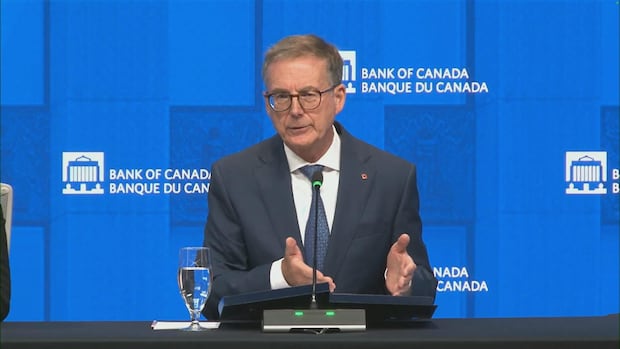
Tiff Macklem, the governor of the Bank of Canada, stated that while officials will revise their estimates, they currently view the ‘inflationary impact of those counter-tariffs as fairly modest,’ emphasizing that the situation in the Middle East poses a greater concern for inflation.
Simultaneously, tensions in the Canada-U.S. trade conflict have intensified since the bank’s last meeting in July.
Recently, U.S. President Donald Trump implemented 50 percent tariffs on approximately $28 billion worth of Canadian goods. As of Tuesday, Canada will implement similar tariffs on $27.6 billion worth of U.S. products.
In response to the impacts on workers and businesses, the federal government announced a $7.5-billion expanded economic relief program last week. This new assistance is in addition to the nearly $25 billion in tariff support provided over the last 18 months.
Macklem: Inflation is ‘too high’
Canada’s inflation rate reached three percent in July, as the tensions in the Middle East affected fuel prices in Canada.
“That level is too high,” Macklem stated, reaffirming the bank’s objective of achieving an inflation rate of two percent. “The rise is primarily concentrated in gasoline and oil prices, which are directly influenced by the conflict in Iran.”
Derek Holt, vice president and capital markets economics head at Scotiabank, noted that Macklem is placing significant emphasis on the upcoming economic forecasts set to be released in October.
“There is a wealth of information to analyze prior to October 28, including inflation data, employment figures, GDP, along with developments in energy markets and trade. However, the BoC has clearly opened the door for potential tightening as soon as the next meeting if conditions align,” Holt remarked in his research note.
He anticipates rate hikes totaling 75 basis points beginning in the fourth quarter of 2026.
Concerns over trade uncertainties
CIBC chief economist Avery Shenfeld expressed that the decision to hold rates steady was expected “in light of the uncertainties surrounding the trade war.”
“The new level of uncertainty concerning trade relations complicates the outlook too much to make definite predictions about future developments,” Shenfeld noted in a research note following the announcement.
“The bank assessed that the direct effect of the most recent round of tariffs would be minimal, but also indicated that trade uncertainties could pose an additional burden,” he added.
“It did not address the potential negative consequences of failing to reduce existing tariffs on autos, metals, and lumber, which many economic forecasts had anticipated would occur.”
Shenfeld believes there is little chance for rate adjustments in either direction in 2026, considering that both the oil market and trade war scenarios could change dramatically in the coming months.
Current bond market conditions
While the central bank directly influences short-term borrowing rates, long-term rates are determined by the bond market. In the U.S., treasury yields have surged to their highest levels in years as investors seek higher returns, partly due to expectations that the U.S. Federal Reserve will increase its short-term benchmark rate.
“We are witnessing some impact of global bond yields on Canada,” Macklem stated on Wednesday, observing that Canada’s yield curve remains significantly lower than that of U.S. treasuries.
“It is crucial to differentiate between volatility and instability or dysfunction when prices and yields fluctuate, as investors are reassessing risk,” commented Carolyn Rogers, Senior Deputy Governor of the Bank of Canada, during the press conference.
“The vulnerabilities we have discussed in previous financial stability reports arise when highly leveraged investors rapidly unwind their positions, leading to decreased liquidity,” she continued. “That is the risk we are monitoring, but we do not see it occurring at this moment.”
The yield on the benchmark 10-year Government of Canada bond rose above basis points to 3.80 percent on Wednesday, marking its highest point in over two years.
A Reuters survey conducted on August 22 revealed that all 35 economists polled anticipated that policymakers would maintain the bank’s key rate during Wednesday’s meeting. The Bank of Canada’s next rate announcement is scheduled for October 28.