

The recent growth in Canada during the second quarter of this year arrives at a crucial moment.
According to Statistics Canada, the economy expanded at its highest rate since 2004, with nearly 90 percent of sectors reporting gains. Energy exports led this growth, while the auto sector, despite facing significant tariffs, also achieved notable improvements.
When viewed collectively, these developments indicate that Canada’s economy has established a modest buffer to withstand future challenges arising from the ongoing trade conflict with the U.S. Economists assert that this cushion is essential for Canada.
“This demonstrates true resilience, but it does not guarantee immunity from a trade war,” remarked David-Alexandre Brassard, chief economist at Chartered Professional Accountants of Canada.
Additionally, Statistics Canada adjusted the growth figures for the first quarter from 0.0 percent to 0.1 percent, meaning Canada did not experience a contraction in consecutive quarters and officially sidestepped a “technical recession.”
“Although the economy was sluggish at the beginning of last year, it was not in a recession,” stated Michael Davenport, senior economist at Oxford Economics.
These numbers were largely expected by both the statistical agency and the majority of economists across Canada.
Douglas Porter, chief economist at BMO Capital Markets, indicated that this upturn suggests the Canadian economy is beginning to recover after a tumultuous 18 months.
He emphasized that the economy is shaped by millions of daily decisions made by consumers and businesses alike.
“These figures indicate that many of these choices have started to turn favorable during the spring,” Porter shared with CBC News.
Nonetheless, not all of this positive momentum is expected to carry into the third quarter, as preliminary estimates from Statistics Canada indicate that growth in July was stagnant.
The latest set of tariffs will impact around five percent of Canadian exports. However, similar to the initial wave of tariffs, the effects will be significant where they apply.
Moreover, uncertainty surrounding these tariffs is likely to exert a greater influence on the economy than the tariffs themselves.

Transport trucks cross the Ambassador Bridge from Windsor, Ont., into the U.S. on Aug. 22. (Dax Melmer/The Canadian Press)
World wants what Canada sells, analyst says
However, not every sector faces the same level of tariff exposure.
Canada’s energy sector is thriving due to rising oil prices, resulting in widespread benefits across the nation.
Manufacturers of machinery and equipment in Quebec and Ontario are experiencing increased demand. Financial institutions, legal professionals, and consultants in Bay Street are reaping the rewards, while marine logistics firms in British Columbia are busy as exports rise.
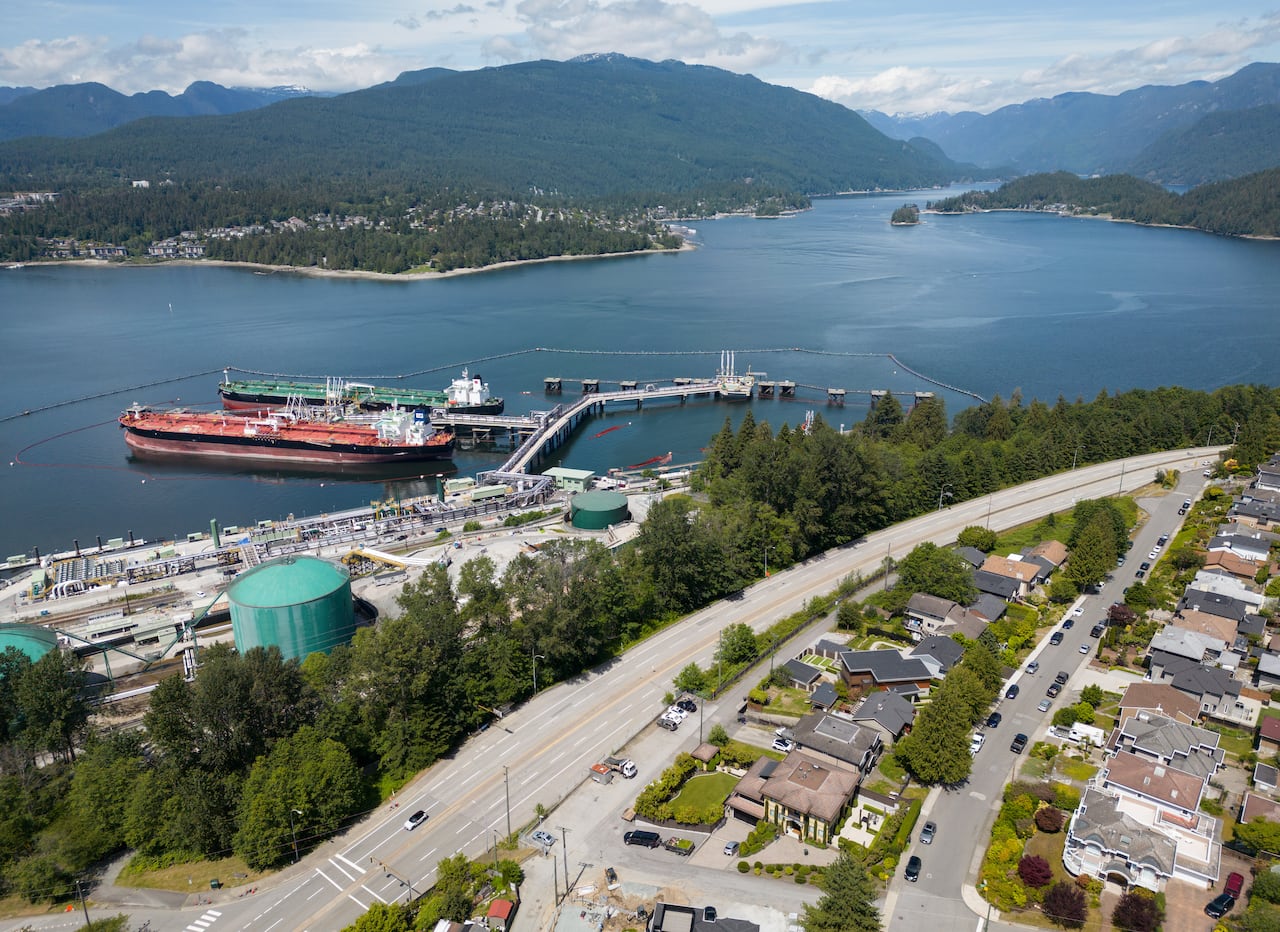
Crude oil tankers docked at the Trans Mountain Westridge Marine Terminal in Burnaby, B.C., where oil from the expanded Trans Mountain pipeline is loaded onto tankers, pictured in June 2024. (THE CANADIAN PRESS)
Energy analysts believe that the resource sector is set to keep propelling Canada’s economic growth.
Heather Exner-Pirot, director of energy, natural resources, and environment at the Macdonald-Laurier Institute think tank, stated, “The significant profits are yet to come.”
She added that recent months have highlighted the global demand for Canadian products, including critical minerals, fertilizers, and energy resources, positioning Canada favorably.
“The overarching message is that we are clearly entering a phase of commodity cycle expansion, and Canada stands out as particularly attractive this time,” Exner-Pirot told CBC News.
She indicated that Canadian producers will likely increase exports and attract new investments in energy and resource infrastructure.
However, she cautioned that this growth is not guaranteed.
“It is vital that we remain ambitious and not become complacent. We have the potential to succeed, but with high expectations and determination, our achievements could be tremendous,” Exner-Pirot remarked.
This distinction will be significant for the economy at any time. However, as Canadian businesses navigate through this next phase of the trade conflict, it will be crucial to discover strategies to enhance growth in sectors less impacted by tariffs, as those most affected are experiencing very tangible challenges.